Water treatment is a set of targeted controls, not a ladder where more cartridges automatically mean better protection. A filter selected to keep grit out of a garden emitter may be entirely unsuitable for a drinking-water concern. Start by naming the source, the intended use and the hazards that need control. Keep non-potable systems separate while those questions are resolved.
Understand the source before the product
For a regulated public supply, begin with the supplier's water-quality information and any current notices. For a private well, tank or collected rainwater source, obtain advice on a suitable testing plan from the relevant health authority or an accredited laboratory. Sampling technique, transport and the selected analyses matter. A basic handheld meter cannot detect every important contaminant or establish microbiological safety.
Consider events as well as normal operation. Flooding, roof contamination, a damaged tank cover, loss of pressure or a cross-connection can change water quality quickly. One satisfactory sample is a snapshot, not a permanent guarantee. Some hazards need source protection or a different supply rather than another household filter. Follow official boil-water or do-not-use notices; a generic filter may not address the stated risk.
Know what each stage can and cannot do
| Process | Typical purpose | Important limit |
|---|---|---|
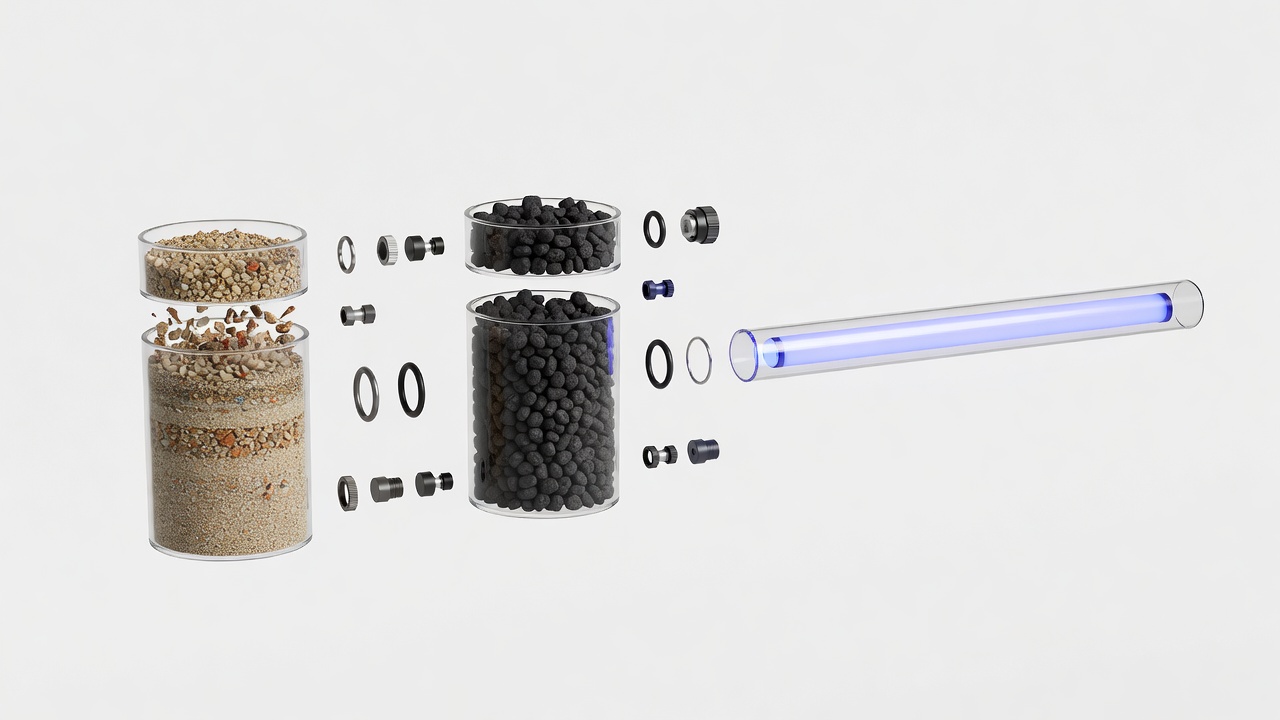
| Sediment filtration | Reduce suspended particles and protect equipment | Not a general microbial or dissolved-chemical barrier |
| Activated carbon | Specified taste, odor or contaminant reduction | Claims vary; not universal disinfection |
| Reverse osmosis | Reduce specified dissolved substances | Needs suitable feed conditions, servicing and reject-water planning |
| Ultraviolet disinfection | Inactivate susceptible microorganisms at a validated dose | Does not remove dissolved chemicals or leave a disinfectant residual |
These descriptions are not equipment specifications. Sediment filters have different ratings and test methods; a nominal rating is not interchangeable with an absolute claim. Carbon performance depends on the medium, contact time, flow and contaminant loading. A small cartridge can reach its useful capacity before a visible change in water appears.
Ultraviolet systems need suitable water clarity and operating conditions. Fouled sleeves, aging lamps, power failure or flow outside the validated range can compromise performance. Reverse-osmosis systems also need correctly maintained components and hygienic storage where a reservoir is used. Neither technology should be treated as a universal cure for an unknown source.
Read the verified claim, not just the badge
Look up the exact model in a recognized certification directory. NSF/ANSI 42 concerns aesthetic effects, while NSF/ANSI 53 covers specified health-related contaminant reduction claims. NSF/ANSI 58 addresses reverse-osmosis systems, and NSF/ANSI 55 addresses ultraviolet microbiological treatment systems. Certification to a standard does not mean every possible contaminant is reduced. Check the specific claim, capacity, flow rate and installation conditions.
Do not confuse a component's materials certification with verified performance of the complete system. Likewise, a replacement cartridge that fits physically may not preserve the original claim. Ask the supplier for current documentation and the ongoing cost of approved consumables. If the documentation does not address your identified hazard, the product has not answered your question.
Make maintenance part of the selection
Before purchasing, list every recurring task: cartridge changes, pressure checks, lamp replacement, sleeve cleaning, sanitizing, sampling and professional servicing where applicable. Confirm that housings can be opened safely and that isolation, pressure relief and drainage are appropriately provided. Installation and electrical work should follow local requirements and manufacturer instructions rather than a generic online sequence.
Keep replacement dates, model numbers and service records together. Follow capacity limits and time limits, whichever applies first. Reduced flow, unusual taste, an alarm or a damaged housing needs investigation; an absence of those signs does not prove the system is working. If performance is uncertain, use a known safe alternative supply and seek competent advice.
Verify the result and protect the boundary
Commissioning should confirm that equipment is installed and operating as intended, and that any required testing has been completed. Establish what happens during a fault: alarms, shutdown behavior, alternative supply and restart procedures. For drinking-water applications, involve qualified professionals and the relevant authority. This website does not certify any treatment train or provide a water-safety determination.
Verification resources
- NSF: water filters, testing and treatment — understand standards and certification claims.
- US EPA: Consumer Confidence Reports — information for customers of US public water systems.
- World Health Organization: Guidelines for Drinking-water Quality — risk-management context, not a domestic installation manual.